AI Tool Guides
AI Tools for HR: The Complete 2026 Guide
Some links in our roundups are affiliate links: if you buy through them we may earn a commission, at no extra cost to you. It never changes which tools we recommend or where they rank — we only list tools we would genuinely tell a friend to use.
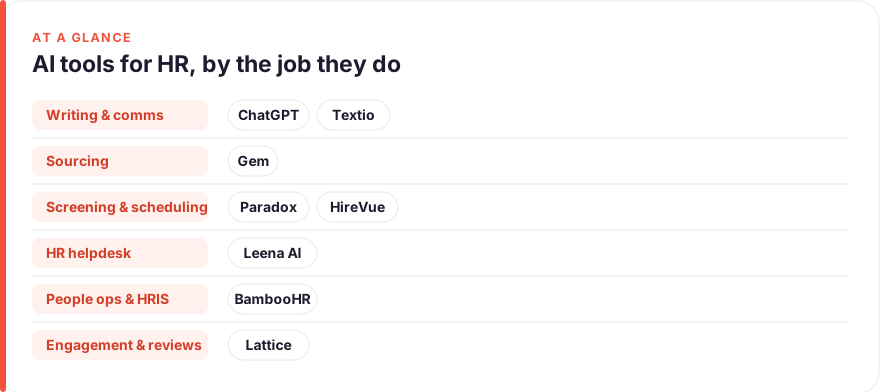
The short answer: For most HR and People teams in 2026, start with ChatGPT for everyday writing and thinking, Textio for bias-checked job descriptions and feedback, and Gem for sourcing and pipeline. Add Paradox for high-volume screening and scheduling, Leena AI for an employee helpdesk, and BambooHR or Lattice once you want AI built into your core HRIS and performance stack. HireVue is a specialist for structured, high-volume interviewing.
HR has quietly become one of the most AI-heavy functions in the business. The work is full of repetitive writing, screening, scheduling and answering the same policy questions over and over, which is exactly what current AI is good at. The catch is that hiring decisions carry real legal and ethical weight, so the tools you choose and how you use them matter more here than almost anywhere else.
This guide ranks eight tools that are genuinely worth your time in 2026, grouped by the job they do rather than by hype. Some are general-purpose assistants you will use daily; others are specialist platforms you buy once you have a specific, high-volume problem. We have flagged who each one is really for, kept prices realistic and hedged, and been clear about where AI in hiring needs a human keeping watch.
- Buy for the job, not the label: sourcing, screening, writing, onboarding, helpdesk and analytics each have a best-fit tool.
- A general assistant like ChatGPT covers most everyday HR writing before you spend on anything specialist.
- High-volume recruiting is where dedicated AI (Paradox, HireVue, Gem) earns its keep; small teams rarely need it.
- Anything that screens, ranks or scores candidates needs human oversight, an audit trail and a bias check — treat AI as a draft, never a verdict.
- Prices below were read from vendor pages in July 2026 and change often; always confirm on the live page.
How we picked these
We looked for tools that solve a real HR job, are widely used enough to be safe bets, and are honest about what they do. We favoured products that keep a human in the loop for anything consequential, and we down-ranked anything that hides how it scores people.
Rankings reflect general usefulness and fit for a typical People team, not a one-size verdict — the right pick depends on your headcount, hiring volume and existing systems. You can read how we test and rank tools on our editorial standards page, and how we handle affiliate relationships on our disclosure page. Some links here may be affiliate links; it never changes what we recommend or the order.
Prices were read from vendor pages in July 2026 and are a snapshot. HR software in particular is often quoted per employee, per month, or by annual contract with custom pricing, so treat every figure below as a starting point and check the live page before you budget.
The shortlist
ChatGPT
Best for: Everyday HR writing and thinkingFree · Plus ~$20/mo · Team ~$25–30/user/mo
The most useful single tool for most HR people, full stop. It drafts job descriptions, rewrites clunky policies into plain English, turns messy notes into a structured offer letter, and rehearses a hard performance conversation before you have it. Use a paid Team plan so employee data is excluded from training, keep genuinely sensitive records out of it, and treat every output as a first draft to check. If you only adopt one tool this year, make it this. See our wider round-up of AI tools for entrepreneurs for how the same assistant carries other functions.
Pros
- Handles JDs, policies, comms and tricky email drafts in seconds
- Genuinely useful for summarising and rehearsing difficult conversations
- Team and Enterprise plans keep your data out of training
Cons
- Will invent specifics if you let it — always fact-check policy and legal points
- Free tier is not appropriate for confidential employee data
/assets/screenshots/chatgpt.png Textio
Best for: Bias-checked job posts and feedbackCustom / quote-based (team pricing)
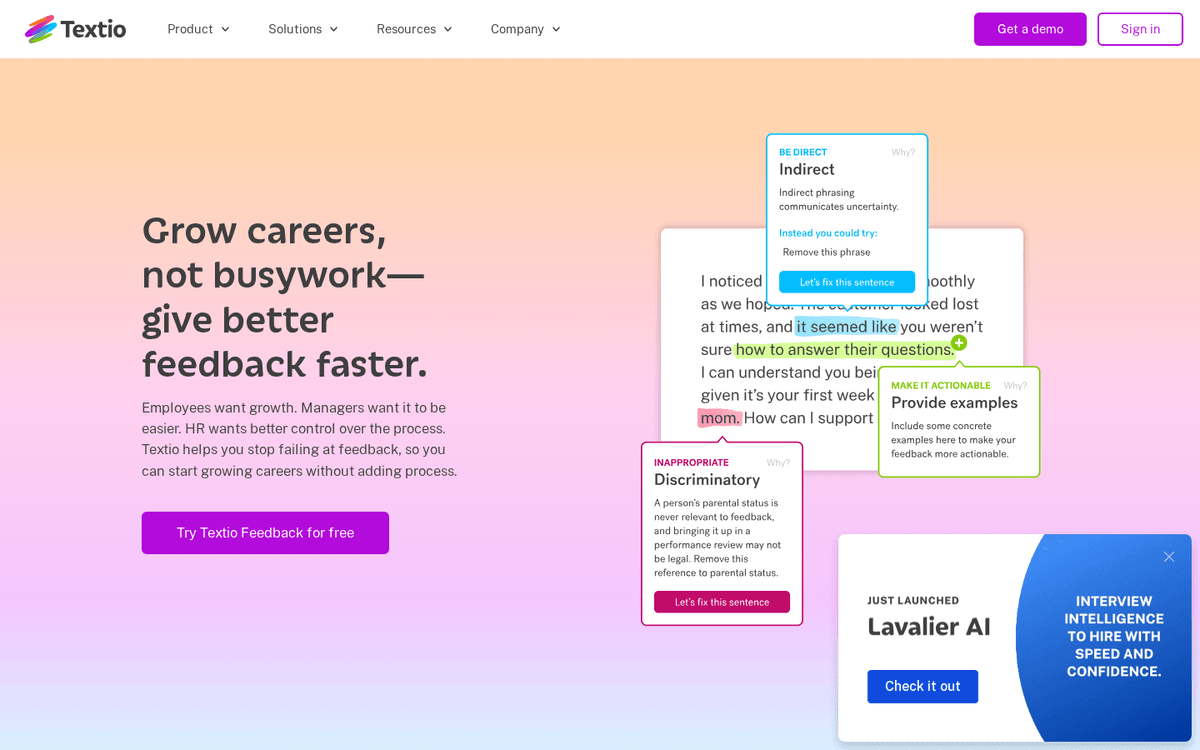
Textio reads your job descriptions and written feedback and highlights language that skews the candidate pool — overly masculine phrasing, age-coded terms, vague hype — while you type. For teams that hire at any scale it is one of the few AI tools that actively pushes hiring towards fairer, clearer language rather than away from it. Pricing is quote-based and aimed at organisations, so a two-person team can get most of the benefit from a good ChatGPT prompt instead. Worth it once inclusive, consistent writing across many hiring managers becomes a real problem.
Pros
- Flags biased or exclusionary language as you write
- Aims to improve job-post response rates and inclusivity
- Extends to performance feedback, not just recruiting
Cons
- Enterprise pricing, so overkill for tiny teams
- Guidance is a nudge, not a legal sign-off
/assets/screenshots/textio.png Gem
Best for: Sourcing and recruiting pipelineCustom / quote-based
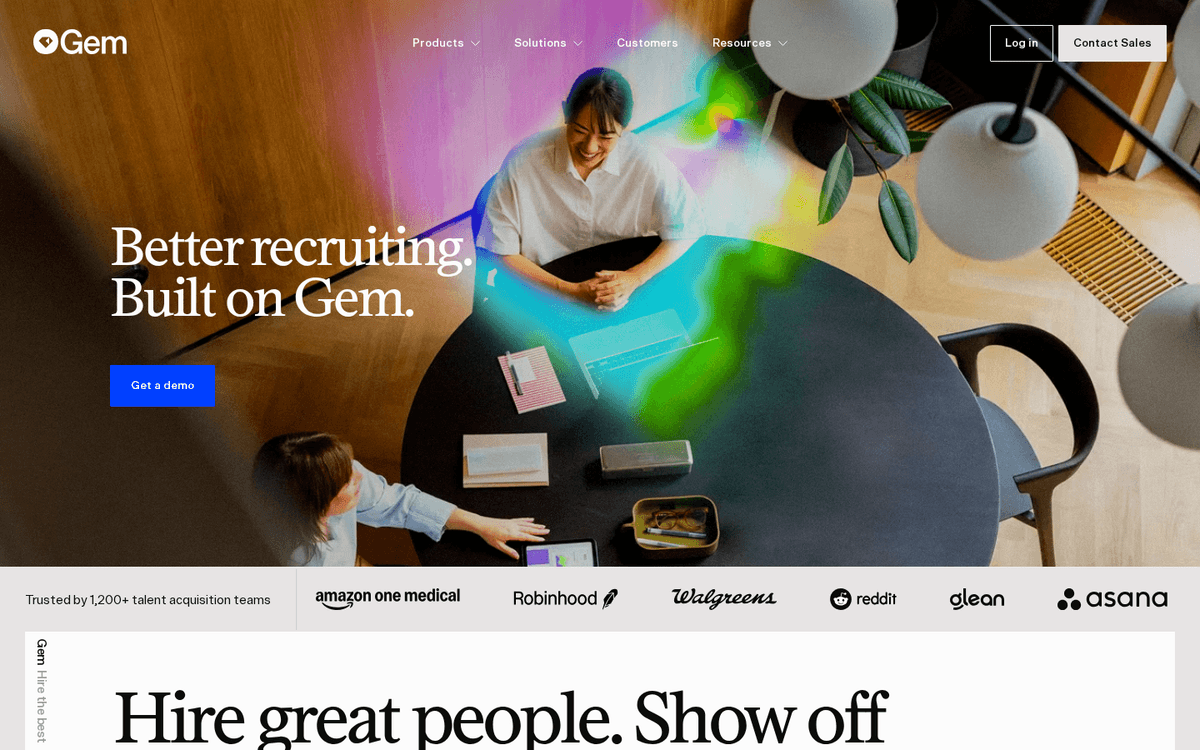
Gem is a recruiting platform built around sourcing, outreach and pipeline analytics, with AI helping find and re-engage candidates and draft outreach at scale. If you run a real talent function — a pipeline, cold outreach, and metrics your leadership asks about — it is a serious contender. The AI is a means to an end here: less time hunting profiles and writing near-identical messages, more time actually talking to people. For occasional hiring it is more than you need; a spreadsheet and ChatGPT will do.
Pros
- Strong candidate sourcing and outreach automation
- CRM-style pipeline and analytics for recruiters
- Integrates with major ATS platforms
Cons
- Priced for teams that hire regularly
- Value drops sharply at low hiring volume
/assets/screenshots/gem.png Paradox
Best for: High-volume screening and schedulingCustom / quote-based
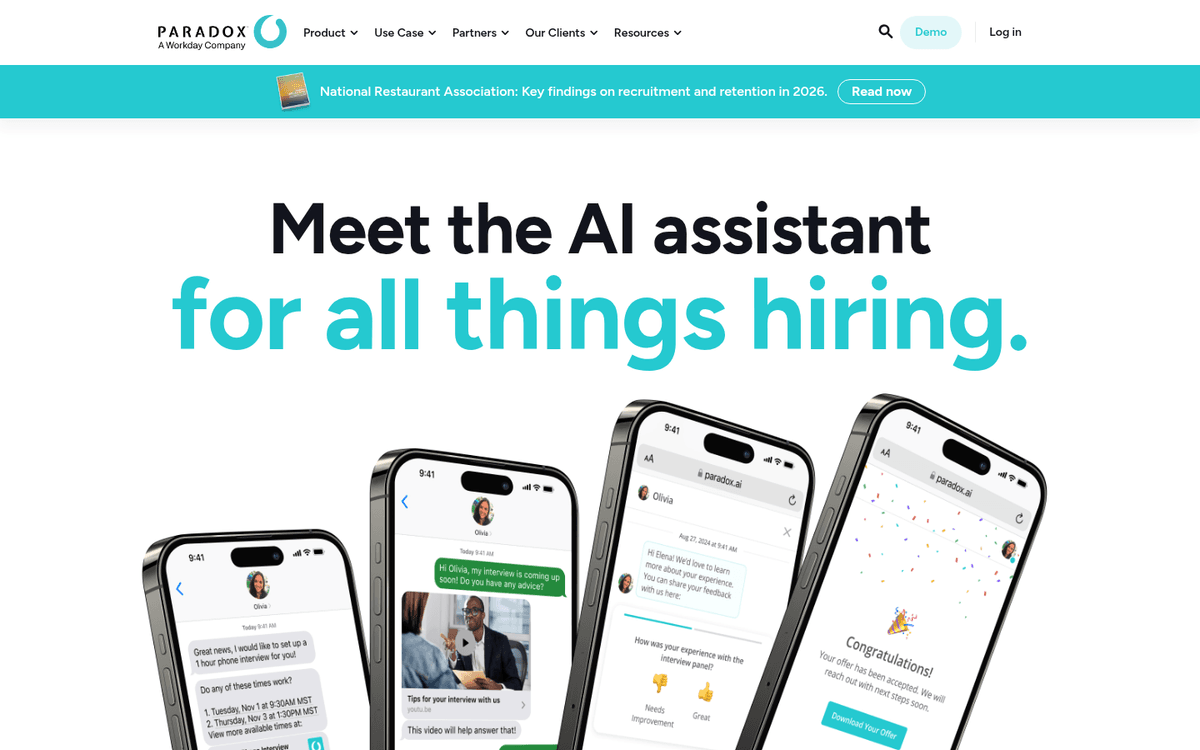
Paradox’s assistant, Olivia, handles the grind of high-volume recruiting: answering candidate questions, running first-pass screening questions, and booking interviews without a recruiter touching a calendar. For retail, hospitality, logistics and other roles where you process thousands of applicants, it is transformative. The care point is real, though: any automated screening logic decides who moves forward, so the questions and knock-out criteria need designing to be fair and job-related, and reviewing over time. Not for teams making a handful of hires a year.
Pros
- Conversational assistant (Olivia) screens and schedules automatically
- Excellent for high-volume, frontline and hourly hiring
- Cuts time-to-schedule dramatically
Cons
- Built for scale — small teams will not fill it
- Chat-based screening needs careful, unbiased question design
/assets/screenshots/paradox.png Leena AI
Best for: Employee HR helpdesk and knowledgeCustom / quote-based
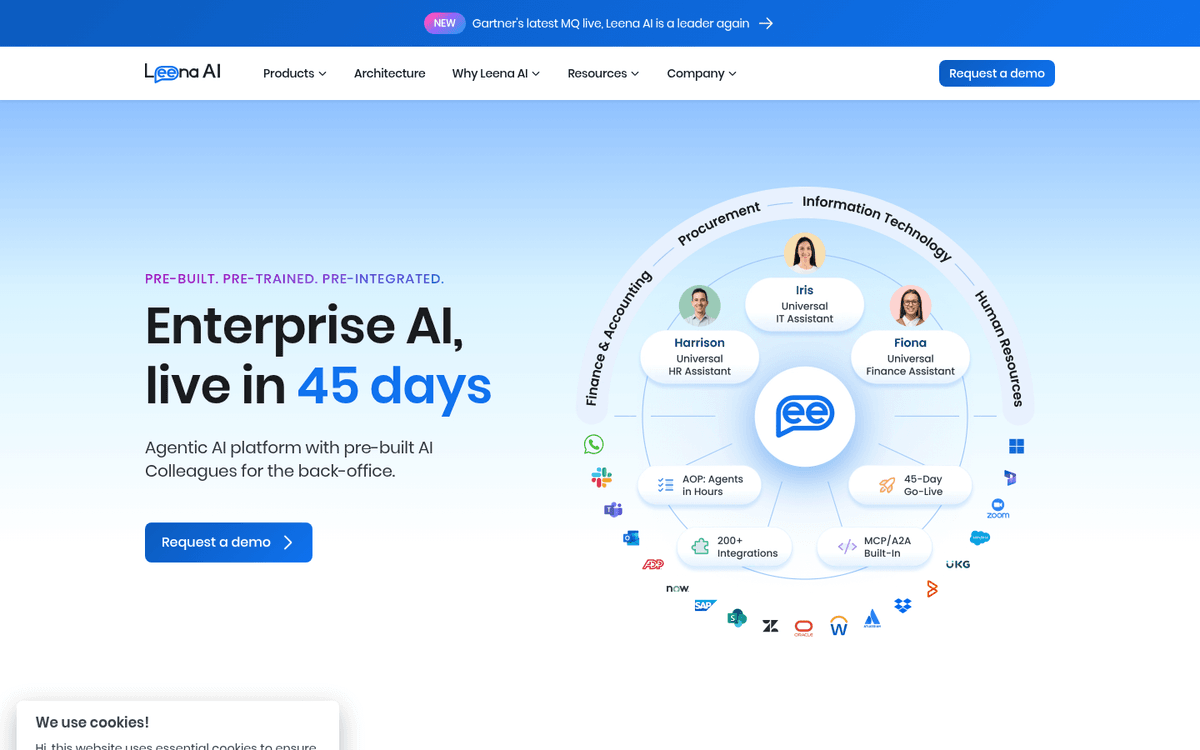
Leena AI is an employee-facing assistant that answers the endless stream of “how much leave do I have left / what’s the parental policy / how do I expense this” questions by drawing on your own documented policies. For mid-size and larger teams it reclaims hours the People team currently spends being a human search engine. It needs well-maintained source content to be trustworthy, and it is an enterprise buy — Moveworks is a comparable alternative if you want to shortlist two. Small teams can get surprisingly far with a well-organised Notion or intranet plus ChatGPT.
Pros
- Answers routine HR questions from your own policies
- Deflects repetitive helpdesk tickets around the clock
- Sits inside Slack, Teams and your HRIS
Cons
- Only as good as the policy content you feed it
- Enterprise deployment and pricing
/assets/screenshots/leena-ai.png BambooHR
Best for: Core HRIS with AI built inQuote-based, typically per employee/mo
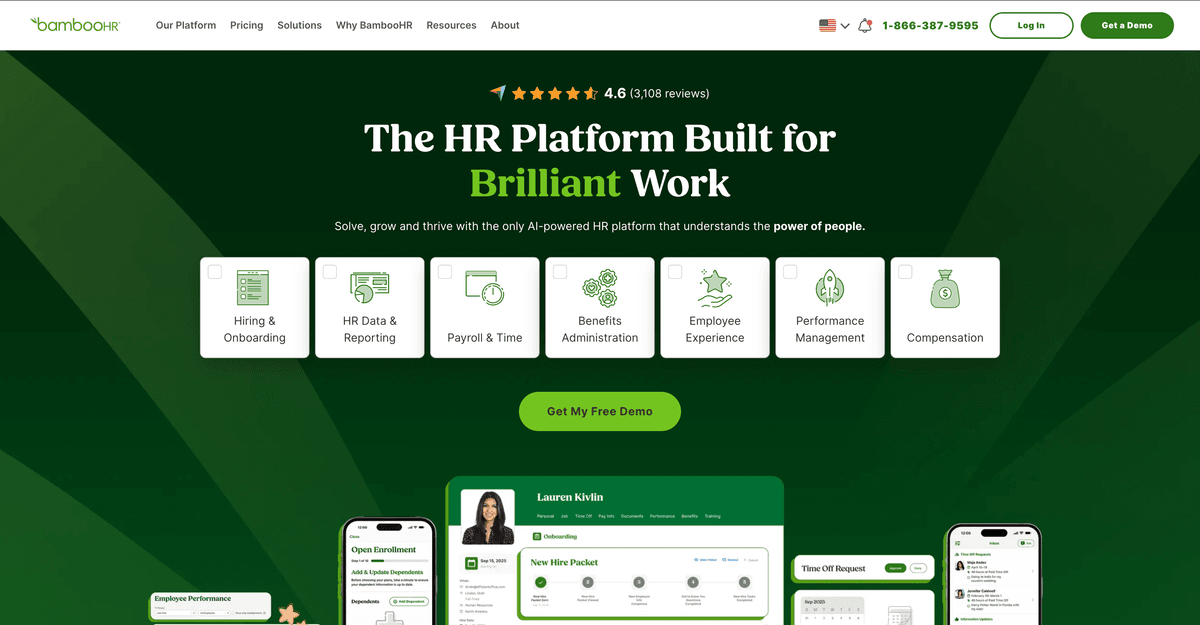
BambooHR is a well-liked core HR system for small and mid-size companies — employee records, onboarding workflows, time off, reporting — now with AI features layered on top for things like summarising data and speeding up admin. You do not buy BambooHR for the AI; you buy it because you need a system of record, and the AI is a useful accelerant. If you are still running HR out of spreadsheets and email, a proper HRIS like this is a bigger upgrade than any point AI tool. Pricing is quote-based and usually per employee.
Pros
- Solid all-in-one HRIS for small and mid-size teams
- AI features layered onto records, onboarding and reporting
- Approachable, non-technical interface
Cons
- AI is a helpful add-on, not the reason to buy
- Per-employee pricing adds up as you grow
/assets/screenshots/bamboohr.png Lattice
Best for: Performance, engagement and People analyticsFrom ~$11/user/mo (module-based)
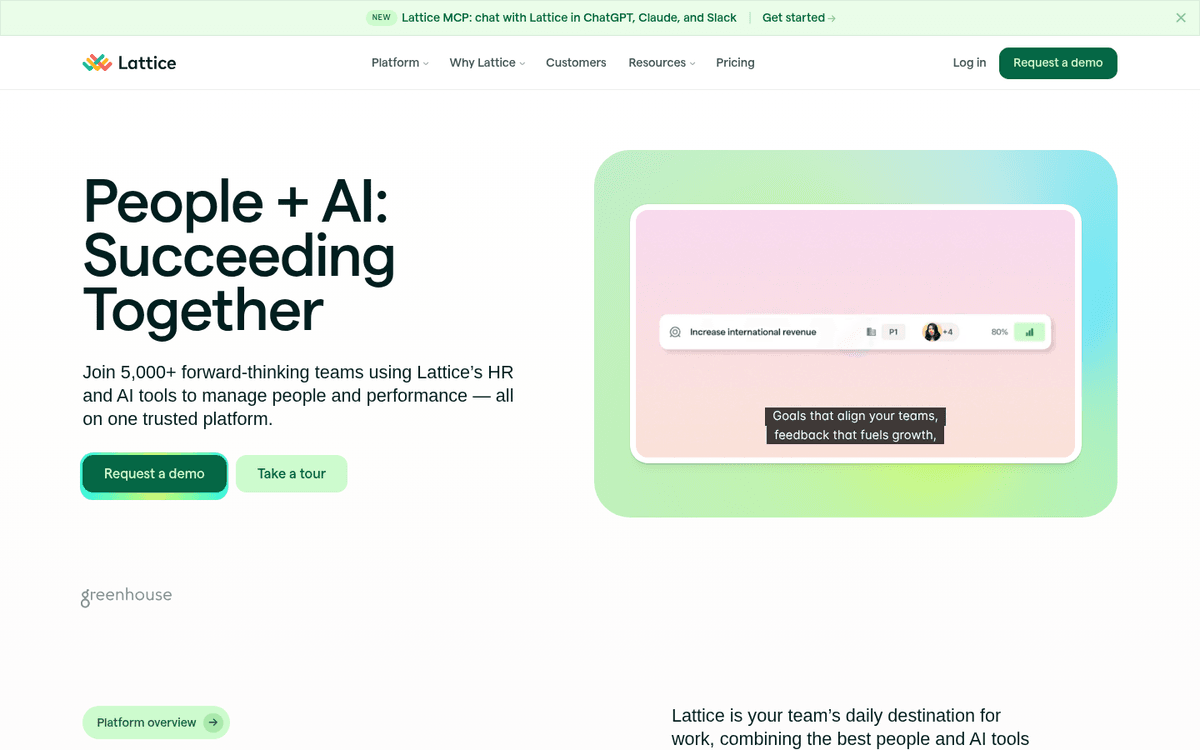
Lattice is a performance and engagement platform — reviews, goals, 1:1s and surveys — with AI that helps managers summarise feedback and draft review write-ups faster. For teams that have outgrown ad-hoc reviews and want People analytics leadership will actually read, it is a strong pick. Treat the AI as a drafting aid: a summarised review is a starting point a manager must own, not outsource. Sold by module, so the headline price climbs as you add pieces — scope what you genuinely need first.
Pros
- Structured reviews, goals and 1:1s in one place
- AI helps summarise feedback and draft review content
- Engagement surveys feed real People analytics
Cons
- Priced per module, so a full stack gets pricey
- AI-drafted feedback still needs a manager's judgement
/assets/screenshots/lattice.png HireVue
Best for: Structured, high-volume interviewingCustom / quote-based
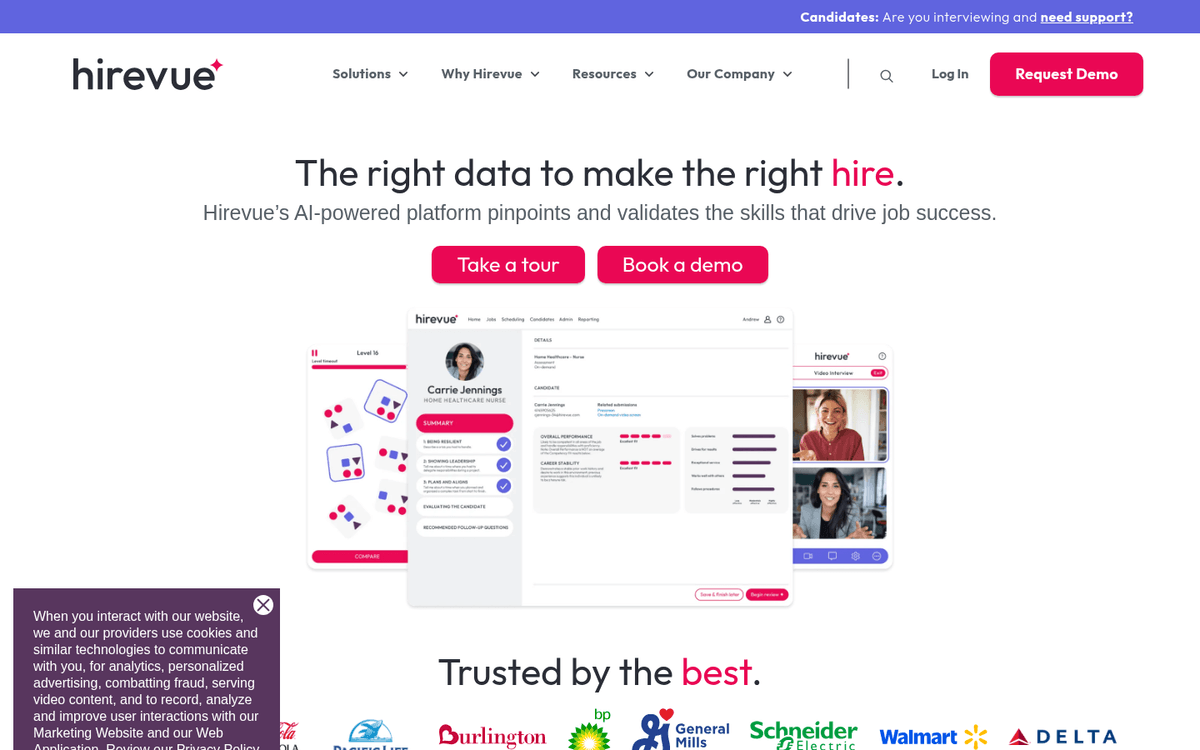
HireVue runs structured video interviews and assessments for organisations hiring in large volumes, standardising the format so every candidate gets the same questions. Used well — as structure and consistency, with humans making decisions — it can make high-volume hiring fairer and faster. Used carelessly, automated scoring of candidates is exactly the kind of AI that invites legal and reputational risk, so it earns its place only for teams that will invest in oversight and auditing. A specialist tool for a specific problem, not a general recommendation.
Pros
- Structured video and assessment interviewing at scale
- Consistent, repeatable evaluation format
- Useful for large graduate and frontline intakes
Cons
- Automated assessment demands rigorous bias auditing
- Candidate experience can feel impersonal if misused
/assets/screenshots/hirevue.png Which AI tools should an HR team actually buy first?
Layer your spending by need rather than buying the whole list.
If you are a small team or a team of one, start and mostly stop with ChatGPT on a paid Team plan. It covers job descriptions, policy rewrites, offer letters, tricky comms and interview prep. Add a proper HRIS like BambooHR when spreadsheets stop coping. That is a genuinely capable People stack for very little money.
If you hire regularly, add a sourcing and pipeline tool — Gem — and, if your writing needs to be consistent and inclusive across many hiring managers, Textio. This is the point where dedicated recruiting AI starts paying back the subscription.
If you hire at high volume (frontline, hourly, graduate intakes), Paradox for screening and scheduling and HireVue for structured interviewing are where the biggest time savings live — provided you commit to designing and auditing the automated steps.
If your team is mid-size or larger, a helpdesk assistant like Leena AI and a performance platform like Lattice tackle the two jobs that scale worst: answering routine questions and running consistent reviews.
FAQ
What is the single best AI tool for HR in 2026?
For most teams it is ChatGPT on a paid plan. It is inexpensive, immediately useful across nearly every HR writing and thinking task, and requires no rollout. Specialist platforms beat it for their specific job — sourcing, high-volume screening, helpdesk, performance — but nothing else covers as much ground per pound. Start there, then buy specialists for the pains that remain.
Is it safe to put employee data into AI tools?
It depends entirely on the plan. Free consumer tiers are not appropriate for confidential employee records, because your inputs may be used to improve the model. Business and Enterprise plans from reputable vendors contractually exclude your data from training and offer stronger controls. Even then, keep the genuinely sensitive material — medical, disciplinary, personal identifiers — out unless your legal and data-protection teams have signed off the specific tool.
Can AI make hiring biased, and how do I stay compliant?
Yes, and this is the most important thing to get right. AI learns from historical data, so it can reproduce and even amplify existing bias in who gets shortlisted. Anything that screens, ranks or scores candidates should be treated as advisory, with a human accountable for each decision, an audit trail of why, and regular checks that outcomes are not skewing by protected characteristics. Some jurisdictions now require bias audits or candidate notice for automated hiring tools, so confirm what applies where you hire. Use AI to add structure and consistency, never to make the final call unsupervised.
Do small HR teams actually need specialist AI recruiting software?
Usually not. Tools like Gem, Paradox and HireVue are built for volume and priced for it. If you make a handful of hires a year, a good ATS or even a shared spreadsheet plus ChatGPT for drafting outreach and screening notes will serve you well. Buy specialist recruiting AI when the volume of sourcing, scheduling or screening is genuinely overwhelming your team — not before.
How much should we budget for AI tools in HR?
For a small team, a paid ChatGPT plan (roughly $20–30 per user per month) plus a per-employee HRIS is a realistic floor. Specialist platforms — Gem, Paradox, Leena AI, HireVue, Textio — are almost all quote-based and scale with headcount or hiring volume, so they can run from modest to substantial annual contracts. Every figure in this guide is a July 2026 snapshot and changes often; get live quotes before you commit.
Where should AI never replace a human in HR?
In any final decision about a person: hiring, promotion, discipline, dismissal or pay. Also in genuinely emotional or sensitive conversations, and in interpreting policy where legal risk is involved. AI is excellent for drafting, summarising, scheduling and answering routine questions. It is not a substitute for judgement, empathy or accountability — the things that make someone trust their People team. For a parallel view on where assistants help and where they should stop, see our guide to AI tools for executive assistants.